Posts

Drip irrigation systems are the most efficient way to water new planted trees and hedges
Watering Trees and Hedges During a Hosepipe Ban

Watering Trees and Hedges During a Hosepipe Ban

Hot, dry summers are becoming increasingly common across the UK, bringing hosepipe bans and raising an important question for gardeners.

Last updated: July 2026

Can you water newly planted trees and hedges during a hosepipe ban?

Most water company’s allow managed watering methods such as automated drip irrigation, but please check with your local water company’s restrictions. Whatever the rules, the key to successful establishment isn’t using more water, it’s using water efficiently and directing it where plants need it most.

With the right planting methods and sensible watering practices, newly planted trees and hedges can establish successfully, even during prolonged periods of dry weather.

Why We Recommend Drip Irrigation

Where possible, we recommend an automated drip irrigation system as one of the most efficient ways to water newly planted trees and hedges.

Unlike sprinklers, drip irrigation delivers water slowly and directly to the root zone, reducing evaporation and ensuring moisture reaches the plant rather than the surrounding soil. Water is absorbed gradually, encouraging roots to grow deeper and helping plants become more resilient.

For longer hedges, specimen trees and larger planting schemes, drip irrigation provides consistent moisture while making the best use of every litre of water.

Always check the latest guidance from your local water supplier before using any irrigation system, as restrictions vary between water companies.

What Is a Hosepipe Ban?

A hosepipe ban, officially known as a Temporary Use Ban (TUB), is introduced by water companies to protect water supplies during periods of exceptionally dry weather.

The restrictions are not identical across the UK. Some activities may be prohibited by one supplier but permitted by another, so it is always worth checking the latest advice for your area.

While restrictions may affect how you water your garden, they do not change the fact that newly planted trees and hedges need careful attention during their first growing seasons.

Why Newly Planted Trees and Hedges Need Water

Whether you’ve planted an instant hedge, a screening tree or a specimen tree, the first two growing seasons are the most important for successful establishment.

Until roots spread into the surrounding soil, plants rely on the moisture available within and immediately around the original rootball. During prolonged dry weather, allowing this area to dry out can slow establishment and place unnecessary stress on the plant.

Deep, occasional watering is generally more effective than frequent light watering, encouraging roots to grow downwards in search of moisture and producing stronger, healthier plants in the long term.

Why Practical Instant Hedge™ Performs So Well

Successful summer planting isn’t simply about watering, it starts with the quality of the root system.

Practical Instant Hedge™ is grown in one-metre troughs at our Buckinghamshire nursery, allowing each section to develop a dense, fibrous root system before it leaves us. Because the entire rootball remains intact during planting, transplant stress is minimised and the hedge establishes quickly when planted correctly.

Unlike bare root hedging, which can only be planted during the dormant season, Practical Instant Hedge™ can be planted throughout the year, making it an excellent choice when an instant screen or mature boundary is needed without waiting for winter.

Combined with good soil preparation and sensible watering, it gives plants the best possible start while making efficient use of available water during dry weather.

Five Ways to Water More Efficiently

If you are watering manually, a few simple techniques will make every drop count:

  1. Water deeply rather than little and often. This encourages deeper root growth and improves drought resilience.
  2. Water early in the morning or later in the evening. Cooler temperatures reduce evaporation.
  3. Direct water to the base of the plant. Wetting the leaves does little to benefit the roots.
  4. Apply organic mulch. Mulch helps retain moisture, suppress weeds and keeps the soil cooler.
  5. Prioritise newly planted trees and hedges. Established plants are generally much better able to tolerate dry conditions.

These simple measures often have a greater impact than simply using more water.

Trees and Hedges Have Different Watering Needs

Although the principles are the same, trees and hedges establish slightly differently.

Newly planted specimen trees and larger screening trees have a greater leaf area, meaning they can lose more moisture during hot weather and often benefit from careful monitoring during prolonged dry periods.

Evergreen hedges, meanwhile, continue to lose moisture through their leaves throughout the year and appreciate consistent watering while they establish.

Whichever you choose, good soil preparation and careful watering during the first two growing seasons will lay the foundations for healthy, resilient plants.

Professional Planting Makes a Difference

Correct planting is every bit as important as careful watering.

Preparing the planting area properly, improving the soil where necessary and planting at the correct depth all help trees and hedges establish more quickly and make better use of available moisture.

Many of our customers choose our professional planting service, particularly for larger hedges and specimen trees, giving them confidence that their investment has been planted correctly from the outset.

Looking Ahead

As the UK’s climate continues to change, periods of hot, dry weather are becoming more common. Choosing high-quality nursery-grown plants, preparing the soil properly and watering efficiently will all help create healthier, more resilient gardens.

At Practicality Brown, we’ve spent decades growing and planting premium trees and hedges for gardens, landscapes and commercial projects across the UK. Whether you’re creating an instant screen, replacing a boundary hedge or selecting specimen trees, our experienced team is always happy to offer practical advice.

Planning a Garden Project?

If you’re planning a new hedge or tree planting project, we can help you choose the right plants for your site and advise on planting, watering and establishment.

Browse our range of hedges and trees, or contact our team to discuss your project.

You may also find our previous guide to Irrigation and Hosepipe Bans helpful if you’re looking for more information on irrigation systems and previous restrictions.

drip irrigation system in close up

Frequently Asked Questions

Can I water newly planted trees during a hosepipe ban?

The rules vary between water companies, so always check the latest guidance from your local supplier. Whatever the restrictions, newly planted trees should be watered responsibly while they establish, using the most efficient method permitted. We recommend automated drip irrigation.

Is drip irrigation better than using a sprinkler?

Yes. Drip irrigation delivers water directly to the root zone, where it is needed most, while reducing evaporation and unnecessary runoff. It is one of the most water-efficient ways to establish newly planted trees and hedges.

How often should I water a newly planted hedge?

This depends on the weather, soil type and the size of the hedge. During warm, dry weather, it is generally better to water thoroughly when the soil begins to dry rather than applying small amounts every day. We recommend automated drip irrigation for our Practical Instant Hedge™.

Do established hedges need watering?

Most established hedges are surprisingly resilient. However, prolonged periods of hot, dry weather may mean they benefit from occasional deep watering, particularly if they are growing in light, free-draining soils.

Are some trees better suited to hot, dry summers?

Yes. While all newly planted trees need watering until established, some species are naturally more tolerant of dry conditions once mature.

For inspiration, read our guide to the best shade trees for UK gardens, which includes species that provide welcome cooling shade and are well suited to increasingly warm summers.

Can Practicality Brown plant my hedge for me?

Yes. We offer a professional planting service for many of our hedging and tree products, helping ensure they establish successfully from day one.


Image Credit: Drip System Stock photos by Vecteezy

Create shade in your garden using trees
Best Shade Trees for UK Gardens

Best Shade Trees for UK Gardens: How to Cool Your Space This Summer

Discover the best shade trees for UK gardens and learn how the right semi-mature tree can create cooler, more comfortable outdoor spaces. From compact ornamental trees for small gardens to larger canopy trees for expansive landscapes, our expert guide will help you choose the perfect tree for natural shade.

How to Create Cooler Outdoor Spaces with Trees for Natural Shade

As UK summers become warmer and periods of extreme heat become more frequent, gardens are having to work harder than ever before. Outdoor spaces are no longer simply somewhere to admire from the house – they’ve become places to relax, entertain, work and spend time with family and friends. Creating natural shade is now an important consideration in garden design, helping outdoor spaces remain comfortable and enjoyable throughout the summer months.

Yet as temperatures rise, many gardens become uncomfortable during the hottest parts of the day. South-facing patios can become too hot to enjoy, lawns dry out more quickly, and plants can struggle under prolonged periods of intense sunshine.

Fortunately, nature has already provided one of the most effective solutions: trees.

The right tree does much more than cast shade. It cools the surrounding air, creates comfortable outdoor living spaces, supports wildlife, improves air quality and brings year-round beauty to the landscape. Whether you have a compact courtyard garden or a generous family plot, choosing the right tree can transform how your garden feels and functions.

Why Trees Are the Best Way to Cool a Garden

Unlike pergolas, parasols or shade sails, trees don’t simply block sunlight – they actively cool the environment.

Their leafy canopies intercept solar radiation before it reaches the ground, while thousands of leaves release moisture into the air through a natural process known as evapotranspiration.¹ This process reduces surrounding air temperatures, creating noticeably cooler spaces beneath and around the canopy.

Research from the World Resources Institute suggests that strategically planted trees can reduce surface temperatures and make outdoor spaces feel significantly cooler, with differences of up to 14°C recorded in some urban environments.2

Studies published by the Arboriculture & Urban Forestry journal also highlight that the greatest cooling benefits come from selecting appropriate tree species with healthy, well-developed canopies, while the combined effects of shade and evapotranspiration significantly reduce ambient temperatures.3

In practical terms, that means:

  • Cooler patios and terraces
  • More comfortable outdoor dining areas
  • Reduced heat reflected from paving
  • Better moisture retention in borders and lawns
  • Less stress on surrounding planting
  • Improved habitat for birds, bees and beneficial insects

Trees also provide nesting sites, shelter and seasonal food sources, making them one of the most valuable additions to any wildlife-friendly garden. As our climate continues to change, shade trees are becoming an increasingly important part of resilient garden design.

Choosing the Right Shade Tree

One of the biggest misconceptions is that you need a huge tree to create meaningful shade.

In reality, many smaller ornamental trees produce beautiful, dappled shade that’s ideal for patios and seating areas, while medium-sized trees can comfortably cool an entire family garden without overwhelming the space.

The key is selecting a species that suits both your available space and your long-term aspirations. It’s equally important to consider the tree’s eventual height and spread, ensuring it has sufficient room to mature while providing shade exactly where it’s needed.

Best Shade Trees for Small Gardens

Smaller gardens often benefit from trees that create filtered or dappled shade rather than dense cover. This allows plenty of natural light to reach surrounding planting while making seating areas far more comfortable during summer.

Malus ‘Evereste’

This ornamental crab apple offers spring blossom, colourful fruit and excellent seasonal interest. Its compact canopy creates gentle shade that’s perfect for outdoor dining areas while also providing an important food source for pollinating insects and birds. Mature height: 3-7m

Ligustrum japonicum (Japanese privet)

A compact evergreen tree with attractive small scented white flowers that appear from mid-summer to early autumn, followed by small round black berries. A pretty tree suitable for many gardens. Mature Height: 3-7m

Ilex aquifolium ‘Nellie R Stevens’

This is an attractive evergreen holly with lustrous, glossy green foliage. Its bright red berries provide valuable food for birds through autumn and winter, while its dense evergreen canopy offers year-round screening and welcome shade, making it an excellent choice where privacy is just as important as cooling. Mature Height: 3-5m

Looking for something a little more architectural? Multi-stem trees are an excellent choice for adding character as well as shade. Available in species such as Photinia Red Robin and Osmanthus aquifolium, they create an immediate architectural focal point with their sculptural branching. Their naturally airy canopies provide soft, dappled shade, making them particularly well suited to smaller gardens, courtyards and contemporary landscape schemes.

Best Shade Trees for Medium Gardens

Where a little more space is available, medium-sized trees can create generous areas of cooling shade while becoming striking focal points within the landscape.

Birch Trees (Betula)Perfect tree for garden shade

Birch trees are an excellent choice where light, dappled shade is preferred. Their elegant forms allow filtered sunlight to reach the ground while creating cooler, more comfortable seating areas.

Betula pendula (Silver Birch) has branches that are flexible, with a tendancy to weep or droop. The bark starts white but, as the tree matures it develops attractive dark, deep fissures. Mature Height: 20m

Betula utilis ‘Jacquemontii’ (West Himalayan Birch) has more upright branches and distinctive thin, white bark that peels easily. Mature Height: 18m

Sorbus aucuparia Sheerwater Seedling’ (Rowan/Mountain Ash)

This urban-friendly Mountain Ash offers delicate, airy foliage that filters sunlight beautifully. Clusters of white flowers are followed by vibrant berries, attracting birds throughout autumn while providing light shade that works particularly well in wildlife-friendly gardens. Mature Height: 7-12m

Prunus cerasifera Nigra

A deciduous ornamental purple cherry plum tree that is one of the first trees to blossom in the UK.  The profuse pink flowers remain on the tree whilst the dark foliage begins to emerge, gradually fading to white and contrasting fantastically with the small blackish-purple leaves. Mature height: 10m

Shade Trees for Larger Gardens

If space allows, larger canopy trees become defining features of the landscape.

Species such as English Oak (Quercus robur), London Plane (Platanus × hispanica) and Common Lime (Tilia × europaea) provide extensive shade while becoming part of the garden’s long-term legacy.

Although these trees require careful positioning, they reward patience by creating magnificent outdoor spaces that can be enjoyed for generations.

Where Should You Plant a Shade Tree?

Careful positioning is just as important as choosing the right species.

Think about how you use your garden during the summer. Is there a patio that becomes unbearably hot by late afternoon? A children’s play area with little natural shelter? A seating area that’s only comfortable during the evening?

Planting a tree to provide afternoon shade can dramatically improve comfort without blocking valuable morning sunlight.

It’s also important to consider the tree’s mature size, root spread and proximity to buildings, allowing sufficient space for healthy growth over many years.

More Than Just Shade

While cooling is often the initial motivation, trees deliver a remarkable range of additional benefits.

Healthy trees help capture airborne pollutants, absorb carbon dioxide, reduce surface water runoff during heavy rainfall and provide valuable habitats for wildlife.

Many flowering species also support pollinators, while berries and seeds provide food for birds throughout the year.

Even in winter, deciduous trees continue to earn their place by allowing lower-angle sunlight to reach the garden after leaves have fallen – something permanent shade structures cannot offer.

Trees and Climate Resilience

Across the UK, trees are playing an increasingly important role in helping landscapes adapt to climate change.

Local authorities are expanding urban tree planting programmes to reduce heat build-up in towns and cities, while homeowners are recognising the importance of designing gardens that remain enjoyable despite rising temperatures.

Even the sporting world has embraced the benefits of shade trees. Recent discussions surrounding tree planting at cricket grounds have highlighted how species such as willow can improve spectator comfort, enhance biodiversity and help create cooler outdoor environments.

It’s another reminder that trees aren’t simply decorative, they’re part of the infrastructure that helps make places healthier, more comfortable and more resilient.

Why Choose a Semi-Mature Tree?

One of the greatest advantages of planting semi-mature trees is that many of the benefits begin immediately. Rather than waiting years for a sapling to establish, semi-mature specimens provide instant structure, a sense of maturity and meaningful shade far sooner.

For homeowners, this means creating comfortable outdoor spaces from the outset. For landscape architects and developers, it enables newly completed projects to feel established and welcoming from day one.

At Practicality Brown, all our semi-mature trees are Plant Healthy certified, ensuring they are top quality and therefore likely to establish successfully while delivering immediate visual impact.

Trees creates naturally cooler gardens

Best Shade Trees for All Sizes of Gardens

Garden size Recommended trees
Small Malus ‘Evereste’, Ligustrum japonicum, Ilex ‘Nellie R. Stevens’, Multi-stem Osmanthus aquifolium
Medium Birch, Mountain Ash, Prunus cerasifera ‘Nigra’
Large Oak, London Plane, Lime


Frequently Asked Questions

What is the best shade tree for a small UK garden?

For compact gardens, ornamental trees such as Malus ‘Evereste’, Rowan (Sorbus aucuparia), and carefully selected multi-stem specimens provide attractive shade without overwhelming the space. The best choice depends on the size, style and aspect of your garden.

Which tree provides the fastest shade?

Semi-mature trees offer immediate impact regardless of species. Fast-growing varieties such as Lime and Plane establish well and quickly develop larger canopies when planted in suitable conditions.

Can trees really make a garden cooler?

Yes. Trees reduce temperatures by blocking direct sunlight and through evapotranspiration, where water released from leaves cools the surrounding air. Together, these natural processes can significantly improve comfort during hot weather.

Should I choose a deciduous or evergreen tree?

For most gardens, deciduous trees are ideal because they provide welcome shade during summer while allowing sunlight to reach the garden in winter once their leaves have fallen. Evergreens have the benefit of offering year round screening.

How close can I plant a tree to my house?

The appropriate distance depends on the species, mature size and local ground conditions. Seeking professional advice before planting ensures the tree has sufficient room to develop while protecting nearby structures.

Finding the Right Tree for Your Garden

Every garden is unique, and the best shade tree is one that complements both the available space and the way you enjoy your outdoor environment.

Whether you’re looking for an ornamental tree to cast gentle shade across a patio or a larger specimen to anchor a family garden, choosing a high-quality semi-mature tree allows you to enjoy the benefits much sooner.

At Practicality Brown, we grow and supply one of the UK’s largest selections of semi-mature trees, with species suited to gardens of every size. Our experienced team can help you select the right tree for your site, ensuring it provides decades of beauty, biodiversity and welcome shade.

Browse our current Tree Availability List to explore our latest stock or contact our team for expert guidance on choosing the perfect shade tree for your next project.

Whether you’re creating a shady retreat in a compact town garden or designing a landscape for future generations, the right tree will reward you every summer for decades to come.


Sources

  1. Leeds Ecosystem, Atmosphere & Forest (LEAF) Centre. Plants and Water. During evapotranspiration, the Sun’s energy is used to transfer water from the leaves of plants into the atmosphere.  Available at https://leaf.leeds.ac.uk/research/plants-and-water/
  2. World Resources Institute (2025). Urban Trees Have a Cooling Effect. New Research Shows Where They Matter Most. Available at: https://www.wri.org/insights/urban-trees-cooling-potential
  3. Arboriculture & Urban Forestry (International Society of Arboriculture). Rahman, M.A. et al. Tree Cooling Effects and Human Thermal Comfort in Urban Areas: A Review of the Biophysical Processes. Arboriculture & Urban Forestry, Vol. 39, No. 4. Available at: https://auf.isa-arbor.com/content/39/4/157
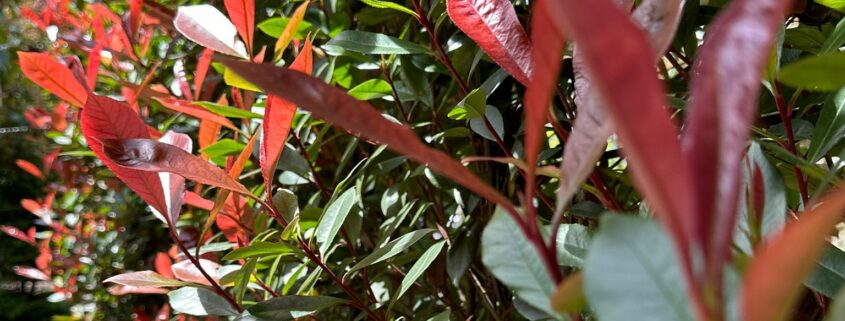
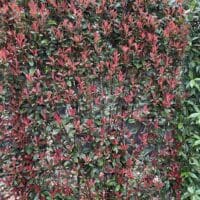
Photinia x fraseri 'Red Robin' bright red new leaf growth on espalier screens.
Evergreen Screening

Evergreen Screening Choices

We have a range of evergreen solutions that offer excellent privacy screening, with their year-round retained foliage. They can serve as windbreaks and even act as a useful security barrier for unwanted visitors.

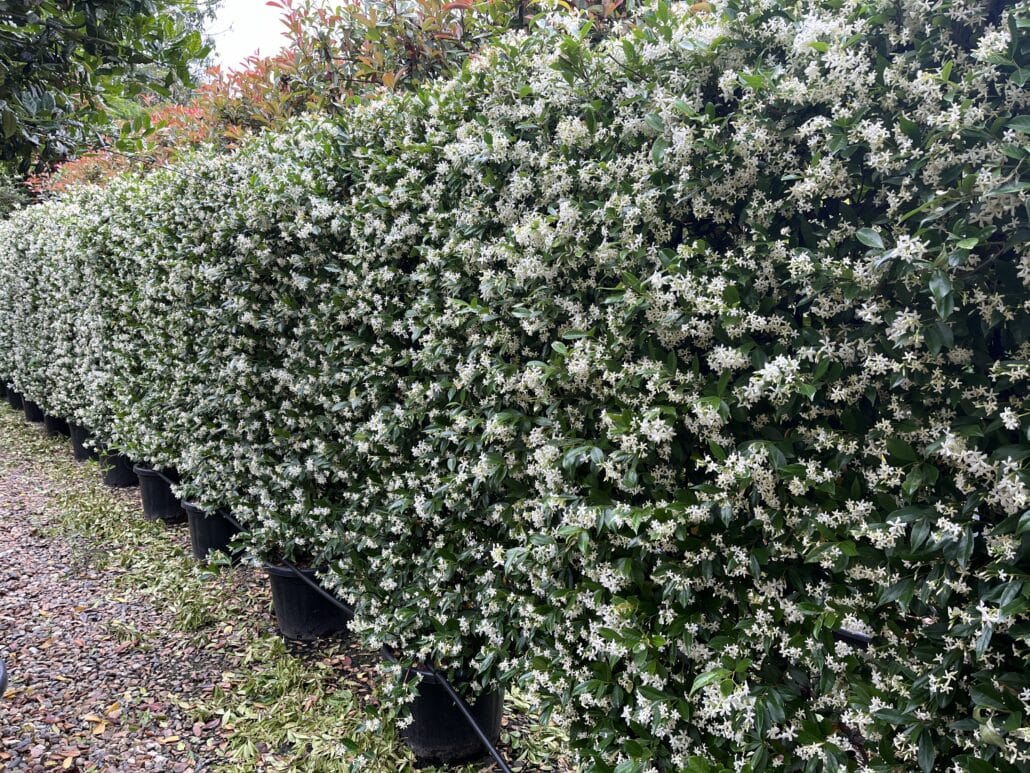
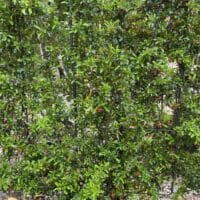
Star Jasmine evergreen screen is a good way to block out unwanted sights

Evergreen Espalier Screens

Our range of evergreen screening now includes espalier screens. These evergreens are grown on strong, narrow frames using several plants in each trough to create full coverage over the framework, from soil level up. Lightweight, simple and easy to install, they are ideal for flexible screening.

The support of the framework allows the plants to grow tall and wide without needing the depth of an Instant Hedge, making them ideal for planting situations where space or time is at a premium. Whether you want to screen out the garden shed, hide the recycling bins or be imaginative by creating rooms in your garden, these narrow screens offer many options.

Our Best Evergreen Screens

There are many evergreen screen varieties available, each with different foliage, features and attributes. These allow you to create a look to fit your garden design, even if you need privacy most in shady areas. We have a variety of species available, both traditional hedging species and newer varieties too.

Variety Size Price
Cupressocyparis leylandii (Leylandii) 300 x 150cm £938
Elaeagnus ebbingei (Oleaster) 150 x 100cm £335
Elaeagnus ebbingei (Oleaster) 160 x 120cm £335
Elaeagnus ebbingei Viveleg (Oleaster) 120 x 80cm £258
Photinia ‘Red Robin’ 200 x 100cm £637
Photinia ‘Red Robin’ 200 x 120cm £456
Photinia robusta compacta 160 x 110cm £456
Photinia robusta compacta 180 x 120cm £543
Prunus laurocerasus ‘Novita’ 180 x 120cm £373
Pyracantha 200 x 120cm £422
Trachelospermum jasminoides 180 x 120cm £442

All prices are per screen and exclude VAT.

A 20% discount will be applied to all ex-VAT orders of these screens worth a total of £3000 or more.

The discount applies to the value of the screens themselves not to delivery or planting etc.

For more information on evergreen espalier screens, instant hedging, screening or pleached trees, contact the horticultural team. Email [email protected] or call 01753 652022 for more information.

In more detail

Cupressocyparis leylandii (Leylandii)

Leylandii is valued for its fast growth habit, sturdy constitution, and dense, evergreen foliage which provides an effective screen. The key for this vigorous grower is regular pruning during the growing season of spring to late summer.

Elaeagnus ebbingei

Highly regarded for its sweet fragrance and tiny bell-shaped white flowers in late summer, it also bears small orange berries in the winter and attractive foliage. Compact with dense growth, it is valuable in coastal locations, as it is salt tolerant.

Photinia ‘Red Robin’

Red Robin’s stand out feature is the vibrant red new shoots in spring, which contrast with the white blossom – unusual in an evergreen.  The bright new leaves change to a deep, glossy green as they mature and are complemented with small round red berries in the summer.

Photinia robusta compacta

This species is more compact than it the ubiquitous Photinia. It has all the leaf colouration of ‘Red Robin’ combined with the compact growth of ‘Compacta’. Forms a very dense shrub with much interest in the spring.

Prunus laurocerasus ‘Novita’

Due to its dense, dark leaves the Novita is commonly planted for screening. It’s leaves emerge a fresh green, which get darker and glossier with age. In spring, they can produce a display of white blossom, which grow on upright racemes.

Pyracantha

With its dense, spiny habit, it makes a perfect screen to use as a security fence to deter intruders. This evergreen boast scented, creamy white flowers in late spring followed by a profusion of orange berries in the autumn.

Trachelospermum jasminoides

This attractive self-twining evergreen climbing shrub has glossy dark green, ovate leaves that often turn a deep red in winter. One of the highlights of this screening plant is the beautiful clusters of white star-shaped flowers in spring, early summer that have a fragrant fresh-sweet scent.

Deciduous screen

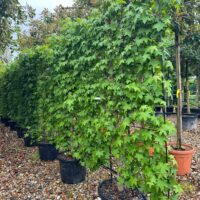
In addition to the range of evergreen espalier screens, we also have Liquidambar styraciflua. This American Sweet Gum of the very best trees for autumn colour and one of the last deciduous species to drop its leaves. The foliage emerges bright green in the spring then changing to fabulous red, purple and gold colours throughout the autumn. Keeping this screen trimmed with not lose the beautiful colours. We have a limited supply of 180 x 120cm screens at £408 each.

Contact to us about your requirements for screening or privacy in your garden; we can supply and plant many types of attractive trees in both evergreen and deciduous species.


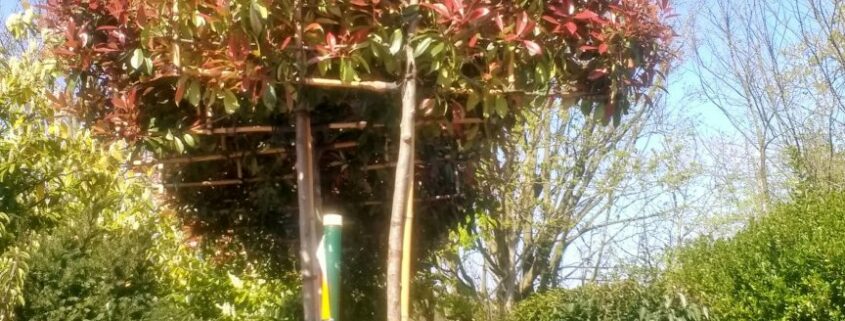
Pleached Photinia Red Robin tree shown growing on the nursery with bright red foliage.
Pleached Trees In Stock NOW

Evergreen Pleached Trees

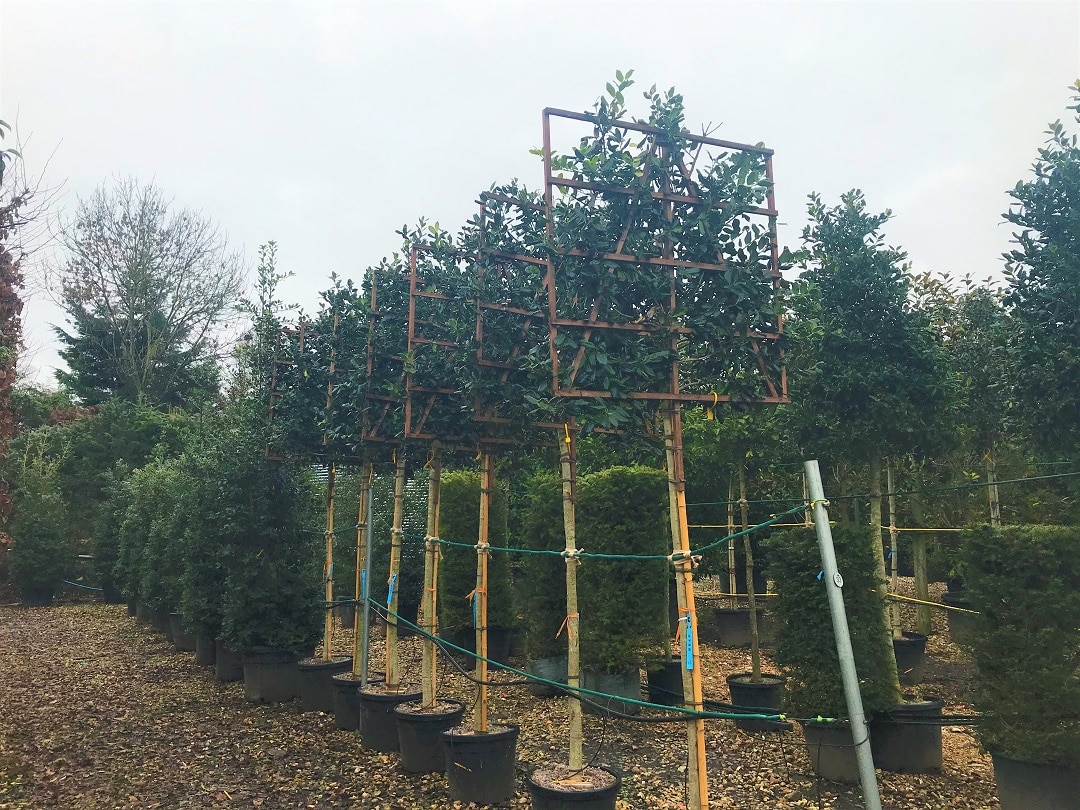
We have just taken delivery of the following evergreen pleached trees our nursery in Iver, Bucks:

Contact us for details

We have these pleached tree, a comprehensive range of standard trees and evergreen screens

Please email [email protected] or complete this form or if you would like to discuss your requirements please call 01753 652022 for more information.

Stock

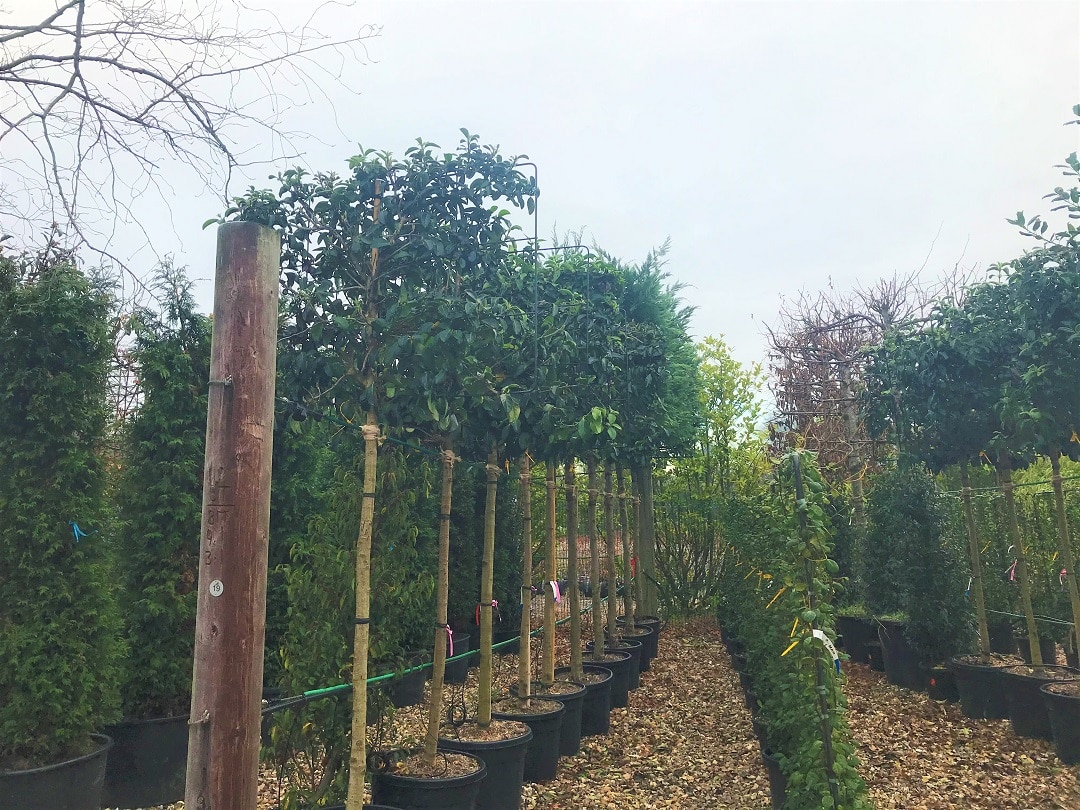
Pleached trees can create effective screening or simply to improve privacy in your garden, without taking up very much space due to their slim canopy.  Pleached trees are created by training trees to a square frame, tying in and interlacing flexible young shoots along a supporting framework, creating an attractive slender tree.


Cupressocyparis leylandii

Commonly referred to as Leylandii, this is a very large and extremely vigorous species hybrid. Valued for its fast growth habit and dense, this evergreen tree provides an effective screen. Usually used in open spaces or as a windbreak, Leylandii can also be used effectively for screening in smaller spaces, such as these pleached trees but it must be regularly maintained and clipped to ensure it is contained for shape and space.


Elaeagnus ebbingei

Pleached Elaeagnus is an outstanding hardy evergreen with tough silvery grey leaves that are frost, wind and salt resistant. Elaeagnus is highly regarded for its sweet fragrance and tiny bell-shaped white flowers in late summer, followed by small orange berries in the winter. A species which positively thrives in coastal environments and all soil types, this makes an attractive pleached tree.


Ilex Nellie R Stevens (Holly)

Ideal for screening due to its symmetrical habit, density and lack of pruning requirements. The glossy green leaves are smooth rather than spikey. The autumn berries provide colour and food for birds. Grows well in well-drained soil, is drought tolerant, needs sun-partial sun.


Ligustrum japonicum (Japanese Privet)

A compact, small sized evergreen tree with camellia-like olive-green leaves that looks attractive in pleached form. It bears large clusters of white flowers in late summer. A tough performing species that will thrive on most soils, but avoid waterlogged areas.


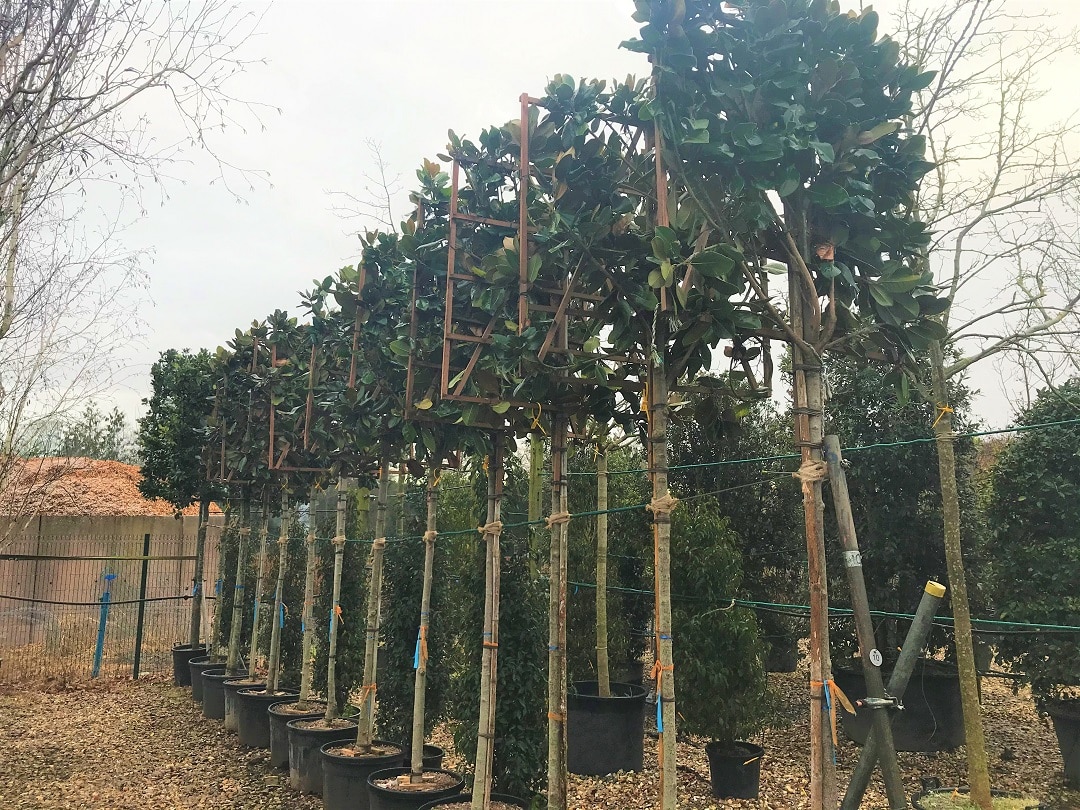
Magnolia grandiflora ‘Gallisoniensis’

With large dark green leaves, this evergreen produces beautiful, large, white flowers in the summer, which can be up to 25 cm in diameter. As well as decorating this stunning tree, they also create a sweet-citrus smelling aroma, and makes a stunning pleached tree. Magnolia grows well in most soils, but it must be sheltered and not north-facing.


Photinia x fraseri ‘Red Robin’

This is a versatile evergreen, that has vibrant red new shoots in spring, which contrast with the white blossom – unusual in an evergreen.  The bright new leaves change to a deep, glossy green as they mature. This tree is a colourful pleached tree.


Viburnum lucidum

This tree has dark green, shiny oval leaves that grow into a dense, busy habit. It produces cymes of small white, fragrant flowers in late winter, which stay in bloom until mid-spring. This tree also produces small, bluish-black berries in autumn.

Photinia x fraseri ‘Pink Marble’

Year-round interest with white springtime flowers and the marble effect foliage.

When the new leaves emerge in spring, they are a strikingly vivid pink and red, creating quite a display. As the leaves mature, the colour evolves to a glossy, dark green with an ivory-white edge or margin and with the occasional splash of pink and white.


Contact to us about your requirements for screening or privacy in your garden; we can supply and plant many types of attractive trees in both evergreen and deciduous species.


Childrens Garden at Kew Gardens
The Secret of a Good Garden

What springs to mind when you think of how you’d like your garden to look? Lush expansive greenery or clear simple lines? An array of beautifully vivid wild contrasting colours or your favourite simple colour theme in a variety of subtle hues. Natural, wild foliage or tightly trimmed and clipped geometrical patterns? We all have our own idea of what makes a great garden.

Whether it’s the view from your window as spring bursts into life, or creating the perfect place to relax and entertain outdoors as the weather turns warmer, if you have structure to your garden it will be much easier to create the look and feel that you’re aiming for, and hedges are the ideal natural way to do this. They are extremely versatile and even popular well known gardeners have been known to say that they are the secret of every good garden.

Hedges have multiple benefits and having grown and supplied mature instant hedging to garden designers, landscapers and private clients, for over 20 years, we know they are also quite unique. The secret to a good garden is that structure is the foundation from which everything else should be planned. A hedge naturally establishes structure, creating a framework that will convey a sense of scale. While many hedgerows may have been growing for hundreds of years, Practical Instant Hedge™  can create full hedging structures instantly.

Creating structure

Boundaries and Partitions
Hedges make some of the best boundaries and dividers. Using hedging to separate your garden into ‘rooms’ or areas is a good option, as they can channel or block views. Low hedges can act as physical barriers to without blocking views, while taller hedges create an outline and can also provide a backdrop for focal points.

Backdrop and Colour
Instant hedging provides a lush green backdrop for other planting. Depending on how the light falls you will see the colour and texture change as well as attractive shadow play. It’s the perfect way to show off your flowering plants that are bursting into bloom in spring, and of course evergreen varieties will even make the view less bare and colourless in winter.

Shelter and Protection
Hedges give your garden more shelter and protection because the wind is broken up by the hedging. With a fence or wall, the wind whistles over the top and can land on the other side with some force, leaving delicate flowering plants or sheltered seating areas exposed to the elements.

Punctuation, Contrast and Framing
Just as commas break up a sentence, gardens need their punctuation points too. Lavish borders need a little geometry to give them structure and instant hedges are ideal for creating this as well as providing contrast for wilder plantings. You also showcase large features or sculptures by using instant hedging as a frame.

We have grown our own range of instant hedges to ensure they are easy to handle and plant all year round, meaning you can add instant structure to any garden. Practical Instant Hedge™  enables you to create the garden you want during the spring and summer months when you can enjoy the benefits immediately without having to wait for the right time to plant.

If you would like to know more about the range of species available and what makes our Practical Instant Hedge special, visit our webpage here, or simply email us [email protected]

Native Mix Instant Hedging
Native Mix Hedges

Garden Hedges

Hedges are aesthetically pleasing and add character to a property, whether they are an integral part of the design, or form a boundary fence.  We have a number of mature hedge options across a range species, both evergreen and deciduous, including the popular Native Mix.


A good hedge has many benefits in addition to being a garden boundary:

Native mix hedge in private garden

Native mix hedge in private garden

  • It provide a good shelter; reducing wind strength better than a solid fence
  • It acts as a filter; absorbing dust and noise
  • It offers privacy; as an effective visual screen
  • It offers a level of security; a prickly hedge is a great deterrent
  • It has natural beauty and interest with seasonal changes
  • It provides background texture and colour to complement other plants
  • Wildlife can benefit from its food and shelter for insects, birds and mammals
  • It is long-lived; many hedges can last hundreds of years


Native Mix Instant Hedges

Native mix hedging contains plants that are all native to the UK and as such emulate traditional country hedgerows found throughout Britain.  Our Native Mix would usually contain a combination of Hazel, Blackthorn, Hornbeam, Dogwood and Hawthorn, all of which are indigenous species.

Close up of Native Mix hedge leaves

Close up of leaves in Native mix hedge


Native Mix hedges creates a natural look and contain a variety of colours and textures which provide a rich living collage for excellent seasonal interest from the early spring blossoms to fruits and berries in the autumn.  All kinds of wildlife will be attracted by the food and shelter opportunities.


Native hedging, by its very nature will thrive on most soil types and can be planted in all but the deepest of shade.  It will tend to grow quite quickly at some 20 – 40 cm per year and will require pruning once a year, ideally in July; it can be left un-pruned, when it will prove even more wildlife friendly.


The Landscape Show 2016

The Landscape Show is a trade event, aimed at garden designers, architects, landscape contractors, local authority landscaping professionals, facilities managers and interior designers from all over the UK and beyond.

Once again we exhibited at the event, which is in Battersea Park London, showcasing the Elveden Instant Hedge.  We were able to talk to new customers and meet up with existing ones.

Thank you to everyone that visited us – we hope to see more of you soon!


RHS Hampton Court Flower Show Results

The RHS Hampton Court Flower Show 2016 has showcased more stunning garden designs this year, made all the more challenging to create due to the unseasonal weather. Practicality Brown are proud to have contributed to the following medal-winning gardens, for which we provided Elveden Instant Hedge, Elements and hedging plants.


Gold Medals

• Show Gardens:

A Dog’s Life Garden designed by Paul Hervey-Brookes for The Dogs Trust

World Vision Garden designed by John Warland (Senseless Acts of Beauty)

• Summer Gardens:

A Summer Retreat designed by Laura Arison and Amanda Waring for CCLA

The Lavender Garden designed by Paula Napper, Sarah Warren and Donna King


Silver-Gilt Medal

• Show Garden: PMS: Outside Inside Garden for NAPS designed by Emma Bannister

• Summer Garden: A breath of Fresh Air designed by Rae Wilkinson for The Abbeyfield Society


Bronze Medal

• Show Garden: Cancer Research UK’s Life Garden designed by Antonia Young Built by Jeff Rosenblatt

Complete garden projects
Elegant trees for impact

A private client in Walton on Thames was seeking trees to complement their front garden and selected trees from our nursery, under the guidance of our experienced horticultural specialist. Five deciduous trees were chosen for appearance and suitability for their location. The chosen trees were a Purple Beech (Fagus sylvatica ‘Purpurea’) with a girth of 35-40cm girth, a Sweet Gum Read more →

Instant Box Hedge with Specimen Topiary Plants

Award-winning Garden Designer, Arne Maynard designed a formal garden for a manor house in Berkshire.

We supplied and planted Elveden Instant Hedge, Box hedge and specimen topiary to create an instant traditional garden in phase one of the garden design.